
A is for Apple Tree Investigation
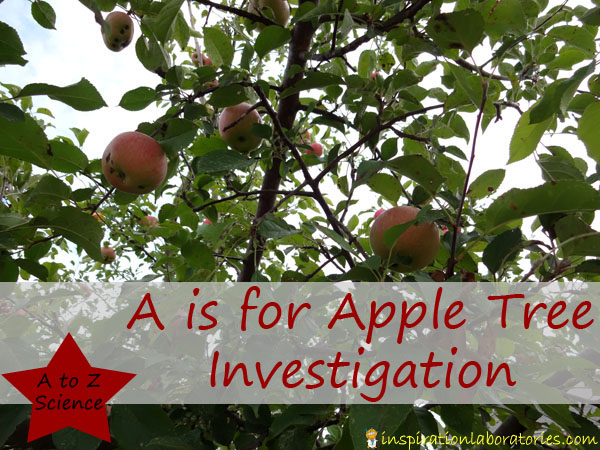
I’m starting a new series today entitled A to Z Science. The goal of the series is to share simple science activities for toddlers and preschoolers. Many of the ideas can also be used with older children. In this series, you can expect to find tried and true science ideas that are loved by many generations. I also hope to share my own spin for some of these activities. For each idea, I’ll be sharing the materials you need, instructions for the activity, questions to ask, and the science behind it. First up is the letter A. A is for Apple Tree Investigation.
What Does Investigate Mean?
What does it mean to investigate something? Investigate means to observe or study closely. Making observations is an essential science skill. Science is the study of the natural world around us. How do we study it? By making observations. We make observations using our 5 senses – sight, hearing, touch, smell, and taste.
Our Apple Tree Investigation
The first thing we did was examine our tree. We looked at the base of the apple tree and saw another tree growing beside it.
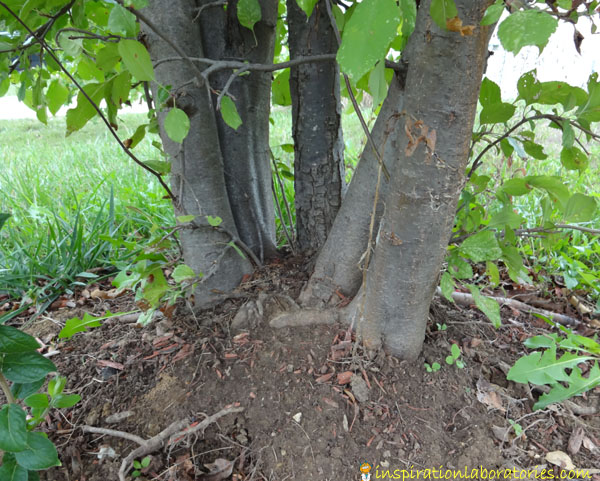
We compared the two trees. We looked at the leaves, the bark, and the fruit of each. The second tree did not have edible fruit, so we focused our investigation on the apple tree. We picked a few apples and examined them. Some of the apples had holes in them.
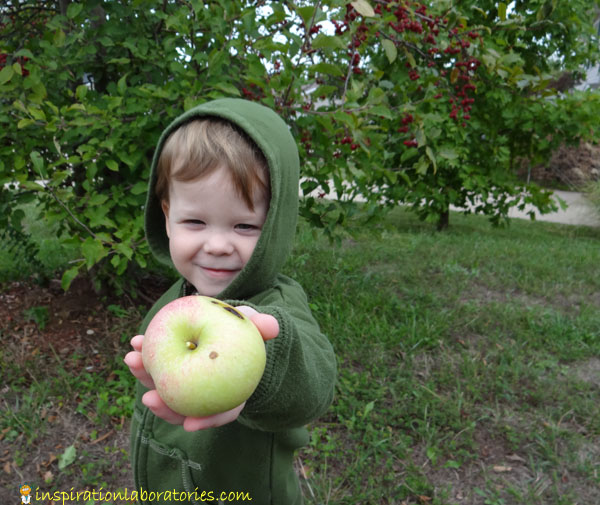
*Question to ask: Why are there holes in some of the apples?
I asked Aiden this question. He said he didn’t know. We then saw an apple on the ground. This apple was starting to rot. It had several kinds of insects on it.
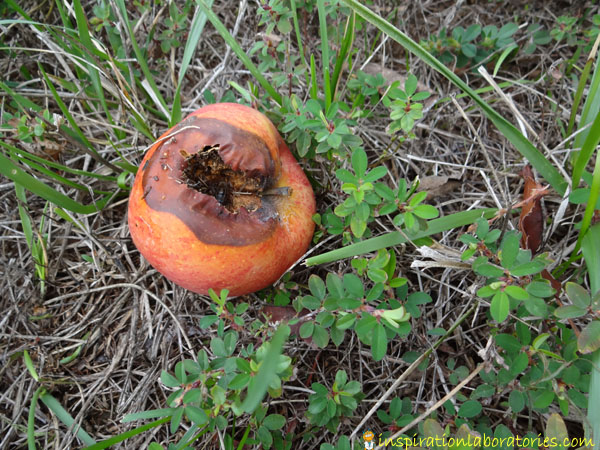
*Question to ask: What do you see on the apple?
Aiden’s answer: I see ants and other bugs!
*Question to ask: What are the ants doing?
Aiden’s answer: They are eating the apple.
*Connect to previous question: Do you think the insects could have made the holes in the other apples?
Yes!
Is the Apple Ripe?
You can determine if the apples are ripe and ready to eat a few different ways {according to the USDA and several others}.
- The color of the apple can be a good indicator. The side of the apple facing the tree is the last part of the apple to ripen. When it changes from a bright green to a creamy color or light green, the apple may be ripe.
- Apples are usually ripe when they start falling off the tree.
- If the seeds are brown {instead of white}, the apple is probably ripe.
- Taste the apple. We conducted a mini investigation to see if our apples were ripe. You can read more about our apple investigation at the outside play series: apples.
What kind of investigations have you done recently? Did you go apple picking this year?
Don’t miss the rest of the A to Z Science series!
Subscribe to the Inspiration Laboratories weekly newsletter. Each issue has exclusive hands-on science explorations for children, a recap of our latest activities, and special resources selected just for you!

Leave a Reply